The rail link is the default choice at all four gateways, not the budget option. The last departure times differ enough to matter: Shanghai's maglev stops at 21:42 while Beijing Capital's express runs past 23:00. And the designated ride-hail pickup zone is inside a parking structure, not at the kerb where you probably expect it.
the arrival card gets you through the border, and then you are standing in an arrivals hall with a suitcase and a decision. older guides describe that decision as taxi versus metro, which was already out of date when they were written. beijing capital has had an express line since 2008, daxing opened with one in 2019, shanghai runs the fastest commercial train on earth to its front door, and guangzhou quietly closed the terminal that half of them still describe. what actually decides the first night is smaller: which train you can still catch, and where the ride-hail cars wait. this page assumes the border step is handled, covered separately in the guide to the digital arrival card.
The last trains, in one table
each airport prints its own first and last departures, and the numbers do not line up across cities. if your flight lands after the cutoff for your airport, skip straight to the late-night section, because the metro plan is dead on arrival.
| Airport | Rail link | Fare | Last train |
|---|---|---|---|
| Beijing Capital | Airport Express (T3 / T2) | RMB¥25 flat | T2 23:10, T3 22:52 |
| Beijing Daxing | Daxing Airport Express | RMB¥35 flat | 23:00, Sunday 23:30 |
| Shanghai Pudong | Maglev to Longyang Road | RMB¥50, RMB¥40 with same-day ticket | 21:42 |
| Shanghai Pudong | Metro Line 2 | by distance | 22:30 |
| Shanghai Pudong | Airport Link Line to Hongqiao | RMB¥26 full run | 22:15 |
| Guangzhou Baiyun | Metro Line 3 from Terminal 2 | by distance | 23:15 |
two readings of that table worth internalizing. first, shanghai's famous maglev is the worst late-night rail bet in the country, because it stops a full hour before the metro does. second, beijing capital's express is the only one still running near midnight, which is why the airport you fly into changes the plan, not just the price.
The express from Beijing Capital
the airport express runs five stops in a line from the terminals to the northeast of the city: T3, T2, Sanyuanqiao, Dongzhimen and Beixinqiao. the fare is RMB¥25 single, flat regardless of distance, paid at a machine or by scanning a transit code, and trains leave roughly every ten minutes. the airport publishes the first and last departures on its own site: from T3 toward the city the last train leaves at 22:52, from T2 at 23:10, and the first trains start between 6:22 and 6:36 in the morning. the stations sit inside the terminal buildings themselves, the T2 platform below the terminal in level B2 of the parking structure, and the T3 station on the second floor of parking structure 3, reached through the corridor opposite international arrivals exit B.
the transfers are what make the line useful. Sanyuanqiao hands you to lines 10 and 12, Dongzhimen to lines 2 and 13, and Beixinqiao to line 5, which together cover most of the districts a visitor or a new resident actually stays in. the ride to Dongzhimen takes about twenty minutes, and from there the city opens up; the gate-level mechanics of riding the network itself live in the separate guide to the metro.
if you are taking a car instead, the pickup points are specific and posted. ride-hail cars wait in parking structure 1, southeast corner on level 1, for T2 arrivals, and in parking structure 3, level B2 zone H, for T3 arrivals, an area upgraded in 2025 with diagonal loading bays so the east and west halves split the crowd. the taxi ranks sit at doors 5 through 9 on level 1 of T2 and in a dedicated hall on level B1 of T3, both dispatch-managed and running around the clock. the airport also offers a fixed-price van service called Yicheda for groups needing seven seats or more, RMB¥130 for the first ten kilometers then RMB¥7 per kilometer, booked at the taxi information desk rather than through an app.
Daxing, the twenty-minute line
daxing's express is the opposite design: three stations only, from the airport through Daxing Xincheng to Caoqiao, about twenty minutes end to end at up to 160 kilometers per hour. the fare is RMB¥35 for the full run on a distance-banded scale, and the airport's last departure toward the city leaves at 23:00, extended to 23:30 on Sundays. the morning side matters too, because the line toward the airport starts at 5:30 from Caoqiao, earlier than almost anything else in the system.
the station hides in plain sight, level B1 of the terminal, one escalator ride below baggage claim. the detail that changes plans is at the other end: Caoqiao is a city terminal, which means check-in, baggage drop and security screening for participating flights happen there, before you ever touch the airport. living in the south of beijing, that turns the express into the front door of the airport rather than a train to it.
daxing also carries mainline rail. the Beijing-Xiong intercity line runs from the terminal's B1 level, twenty-eight minutes to Beijing West station at the fast end, with through service toward Tianjin and Xiong'an. for a traveler connecting from a domestic flight to a rail journey, it is worth knowing the boarding gates split between the east and west sides of B1 and are not connected airside, so check the gate number in the 12306 app before heading down.
Pudong, three rail options
pudong has three rail options, and they serve three different trips. the maglev is the headline: a thirty kilometer run to Longyang Road in about eight minutes, at 300 kilometers per hour on most schedules, the fastest scheduled commercial train ride anywhere. the operator's own fare table reads RMB¥50 single standard class, RMB¥80 return valid seven days, RMB¥100 for the glass-fronted VIP car, and a combo ticket at RMB¥55 that bundles the ride with a twenty-four hour metro pass. the discount almost nobody claims: show a same-day plane ticket or tap a Shanghai transport card and the single drops to RMB¥40. since June 2025 the gates also accept foreign chip cards directly, Visa, Mastercard, American Express and JCB, plus digital yuan hardware wallets, which makes the maglev one of the few rail gates in the country a freshly landed traveler can walk through without a Chinese app. the hours are the catch, 6:45 to 21:40 from Longyang Road and 7:02 to 21:42 back from the airport.
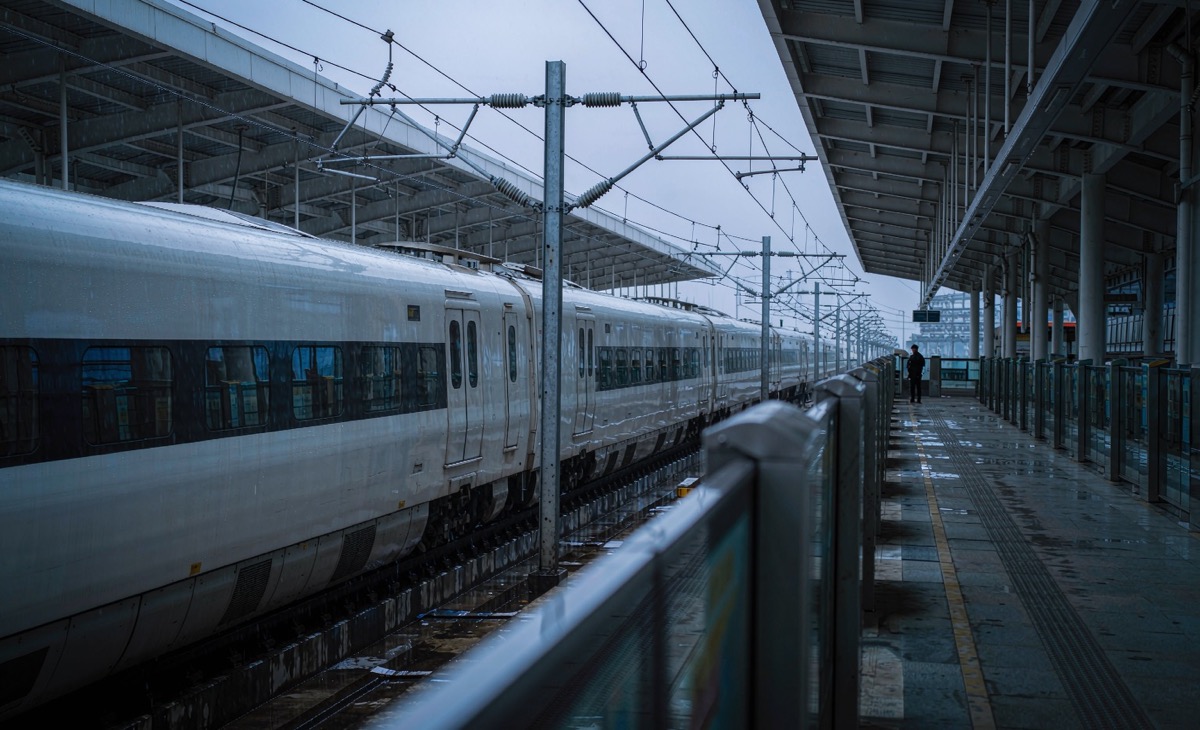
metro line 2 is the workhorse, calling at both terminals on its way across the city toward Hongqiao, running 6:00 to 22:30 from the airport. the airport link line, the newer suburban railway, connects the terminals to Hongqiao rail hub in the other direction, every fifteen minutes or so, 6:00 to 22:15 from the airport and from 5:45 at the Hongqiao end, at RMB¥26 for the full run under a distance-based formula that starts at RMB¥4. it is the right train when the next leg of the journey departs from Hongqiao rather than downtown.
the official airport notice for late arrivals lists the ground options: five bus routes including the Shouhang night line to Hongqiao transport hub, running 23:00 to 5:30, taxis queued at door 11 of T1 and door 26 of T2 on the arrivals level, and ride-hail pickup in the P1 parking bus level or level B2 of parking structure P2, where the platform notes the driver absorbs the parking fee.
Baiyun, the terminal shuffle
guangzhou is the airport where every printed guide is currently wrong. terminal 1, the building most older pages describe, closed to passengers on May 7, 2026 for renovation, and its eleven domestic airlines moved to the new terminal 3. the metro station that served it, Airport South, now runs as a pass-through that skips the stop, and the intercity platform beside it closed too. the parking lots P1 through P4 shut with the terminal.
what works now: metro line 3 stops at Airport North, in the ground transport center beside terminal 2, with service from 6:00 in the morning to about 23:15 at night. terminal 3 has no metro yet, so the connection is a free inter-terminal shuttle from T2, or the intercity railway, which does serve T3 through its own station in the transport center's lower level. south china airlines, the dominant carrier, never left terminal 2, so most long-haul arrivals were unaffected by the shuffle. the taxi kerbs at both open terminals run around the clock, and the arrivals kerb is the only place to take one.
the practical instruction is to check which terminal your airline uses before landing, because the flight number, not the airport code, decides which building you walk out of and therefore which train you can catch.
The queue is safe, the hall is not
the licensed taxi rank at a chinese airport is a dispatched, camera-covered queue with printed fares and a receipt at the end. the person who walks up to you inside the arrivals hall offering a car to the city is none of those things. the airport sites say it plainly: take a taxi at the taxi stand. the scam is rarely violent, it is a padded fare, an unlicensed car, or a detour that a meter would have prevented, and it starts with a friendly approach while you are still looking at your phone.
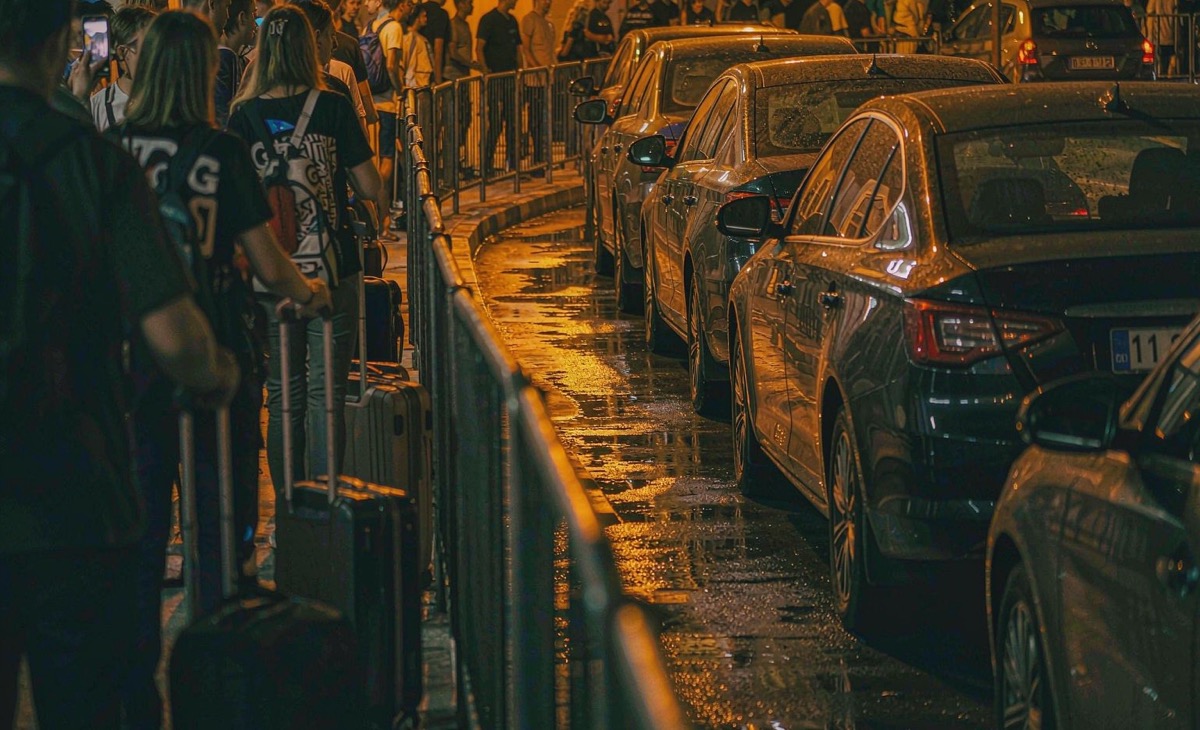
ride-hail changes the geometry instead of removing the problem. at every one of these airports the pickup point is not the kerb outside arrivals, it is a marked zone inside a parking structure, sometimes two levels down. the driver cannot legally collect you elsewhere, so the app shows a pin, and the walk takes five to ten minutes with luggage. travelers who give up and wave down a kerbside car at the arrivals door have abandoned the app's record, the plate match and the fare estimate, which are the three things that make disputes fixable. the queue at the official rank, in other words, is not the hazard. abandoning the system is. the app-level details, fare types and driver-side view, live in the guide to using DiDi.
Landing after the last train
the late-night playbook differs by city but the shape is the same. beijing capital runs night airport buses on core routes until the last domestic flight lands, with departures from the T3 bus area on a published headway. pudong's night bus runs 23:00 to 5:30 toward the Hongqiao hub, and its taxis queue all night at the posted doors. daxing keeps three night bus directions and a taxi rank at doors 18 to 20 on level 1. guangzhou's taxi kerb never closes.
the thing to know before relying on any of it is that the night bus is a local's option, cheap and safe, but it terminates at transport hubs rather than hotels, so the last leg is still a taxi or a ride-hail. a midnight arrival with heavy luggage is the one case where the taxi from the official rank is the correct default rather than the fallback, and the fare is not the thing to optimize at that hour.
Common questions
Is the Shanghai maglev worth RMB¥50?
As transport, rarely, because Longyang Road is still in Pudong and most journeys need a second metro leg after the eight-minute ride. As an experience with a real discount attached, the same-day ticket fare of RMB¥40 or the RMB¥55 combo with a 24-hour metro pass makes it the cheapest speed-thrill per minute in the country. Choose it when the hotel sits on line 2, choose the metro when luggage or children are in the picture.
Can I use DiDi at these airports without a Chinese phone number?
Yes, the app registers with a foreign number and accepts international cards, which the pickups at Beijing and Shanghai are built around. The part that fails is navigation, not payment: the driver waits in a specific zone such as parking structure 3 level B2 at Beijing T3, so follow the in-app pin rather than the kerb. Shanghai's notice even states the driver covers the parking fee at the P1 and P2 pickup zones.
Do I need cash or a Chinese app for the airport trains?
No single method covers everything, which is the honest answer. The Beijing express takes scanned transit codes and transit cards, the Shanghai maglev takes foreign chip cards directly at the gate since June 2025, and metro gates everywhere take the local transport card or code. A funded Alipay or WeChat Pay transit code covers the metro in all four cities, which is why the payment setup belongs before the flight, not at the ticket machine.
What happens if my flight lands after the last train?
Nothing bad, provided you skip the rail idea immediately. Every gateway here keeps a dispatched taxi rank open around the clock, Beijing Capital and Shanghai Pudong run night buses on core routes until early morning, and the fares for a late taxi are metered, not gouged, because the rank is managed. The expensive mistake is accepting a car offer inside the hall instead of walking to the posted rank.
Why does Guangzhou have no metro at Terminal 1 anymore?
Terminal 1 closed to passengers on May 7, 2026 for a full renovation, and the metro station inside it became a pass-through stop as part of the same shutdown. Airlines moved to terminal 3, which has no metro yet, so line 3 serves terminal 2 and a free shuttle or the intercity railway covers the last stretch. Until terminal 1 reopens, any guide listing Airport South as your stop is describing a station that no longer boards passengers.
Are airport taxis metered, and should I ask for a receipt?
Yes to both. Taxis at the dispatched ranks run on the meter at the city's standard tariff, and the receipt, the fapiao, prints the car plate and the trip, which is what turns any later dispute into a five-minute phone call rather than your word against a stranger's. A driver at the official rank who resists the meter or the receipt has told you what kind of ride it would have been, so take the next car in the queue.
Which Beijing airport is better for reaching the city, PEK or PKX?
Depends on where the city ends for you. Capital's express plugs into the northeast at Dongzhimen and Sanyuanqiao, close to Sanlitun and the embassy districts, twenty minutes from the terminal. Daxing's express reaches Caoqiao in about twenty minutes with a connection to lines 10 and 19, and its city terminal at Caoqiao can absorb check-in and bag drop before you travel. Flight schedules usually decide the airport, the table above decides the ground plan.