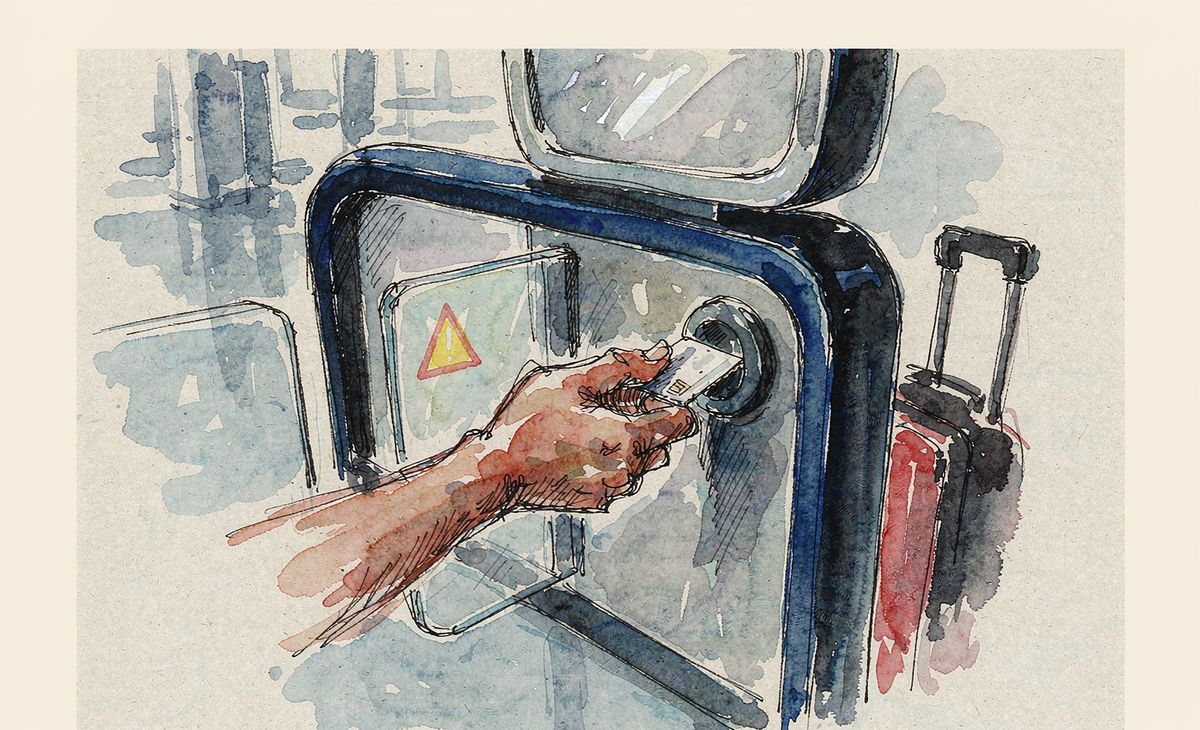
the ticket for the metro in china is probably already in your wallet. since September 2024 in Beijing and since June 2025 across the whole Shanghai network, the fare gates accept ordinary foreign-issued contactless bank cards: Visa, Mastercard, American Express, JCB, UnionPay. you walk up, hold the card to the reader the way a local holds a transit card, the flaps open, and the fare deducts when you tap out. no app, no ticket machine, no queue for change. it is the single biggest change to how foreigners get around Chinese cities in years, and most "how to ride the subway in china" articles have not caught up to it.
the gate reads your bank card the way it reads any local's transit card: tap in, tap out, the fare deducts at the exit. the trick is knowing that in and out must be the same card.
the network behind those gates is the largest urban rail system on earth. at the end of 2025, 54 Chinese cities ran urban rail lines totaling 11,710.3 kilometers with 6,680 stations, and the trains carried 33.2 billion trips over the year, up 3.1 percent on 2024 (Ministry of Transport, January 2026). for a visitor, that scale translates into a simple promise: in every major city, a metro station is usually within walking distance, a ride usually costs RMB¥3 to RMB¥7, and signs and announcements come in English. this page covers the whole chain: paying, fares, passes, the security line, reading the station, and the timing rules that catch people out. every rule below traces to an official page; sources checked 17 October 2026, with fares quoted in RMB¥ (US$1 ≈ RMB¥7.1 at the October 2026 reference rate, so RMB¥3 is roughly US$0.42).
The card in your wallet is a ticket
Beijing went first, in September 2024, and has since pushed contactless card payment to every gate: the city government describes its subway as the first urban rail system anywhere with full-network coverage of all five major card networks, usable for riding, buying single tickets, and topping up (english.beijing.gov.cn, March 2026). Shanghai followed on 28 June 2025, when bank-card tap-and-ride expanded from a maglev pilot to the entire network; the city's central bank branch reported 1.6 million gate transactions and more than RMB¥700 million in fares from the pilot through March 2026 (People's Bank of China Shanghai head office press briefing, April 2026). Chengdu, Guangzhou, and Shenzhen joined during 2025, and Shenzhen switched on in June 2026, so the tap path now covers the cities most visitors land in.
three mechanics matter more than the list of cities. first, the card must be contactless, the same tap-to-pay feature you use at home; a card that only inserts and asks for a PIN will not open a gate. second, banks occasionally decline the first small overseas transaction, so if a gate refuses your card once, the fix is usually a settings change in your banking app (enable overseas or contactless small-value payments), not a trip to the ticket counter. third, and this is written into Beijing's own ticket rules: one card, one person, one journey in and out. tapping in with the physical card and out with the same card loaded on your phone counts as two different tickets, the system logs an incomplete journey, and the gate charges the automatic penalty, which Beijing's rules set at the highest fare from the entry station until staff correct it.
if the card path fails for any reason, the fallbacks are old-fashioned and reliable. ticket machines in Beijing take RMB¥1 coins, RMB¥5, RMB¥10, RMB¥20, and RMB¥50 notes, and bank cards; Shanghai has placed foreign-card POS terminals in every station's service center; and station staff, flagged down with a destination name in English or a point at a map, sell single tickets over the counter.
What a ride actually costs
every Chinese metro charges by distance with a cheap floor, and none of them require a minimum balance trick or zone map. the ladders differ slightly by city:
| City | Starts at | Then | Verified example |
|---|---|---|---|
| Beijing | RMB¥3 up to 6 km | +RMB¥1 at 12, 22, 32 km, then RMB¥1 per 20 km, no ceiling | cross-town trips land near RMB¥4–6 |
| Shanghai | RMB¥3 up to 6 km | +RMB¥1 per 10 km | People's Square to Lujiazui RMB¥3; Hongqiao railway station to East Nanjing Road RMB¥5 |
| Guangzhou | RMB¥2 up to 4 km | +RMB¥1 per 4 km to 12 km, per 6 km to 24 km, per 8 km beyond; network maximum RMB¥20 | a 14-stop ride on Line 11 costs RMB¥4 |
| Shenzhen | RMB¥2 up to 4 km | +RMB¥1 per 4 km to 12 km, per 6 km to 24 km, per 8 km beyond | airport Line 11 rides near RMB¥8–10 |
| Chengdu | RMB¥2 up to 4 km | +RMB¥1 per 4 km to 12 km, per 6 km to 24 km, per 8 km to 40 km, per 10 km to 50 km | cross-city rides rarely exceed RMB¥7 |
two systems sit outside the ladders. airport express lines bill separately: Beijing's Capital Airport line is a flat RMB¥25 and the Daxing airport line runs RMB¥10 to RMB¥35 by distance, both carved out of the normal fare calculation. Shanghai's maglev, the 30-kilometer hop from Longyang Road to Pudong airport, charges RMB¥50 one way, drops to RMB¥40 with a same-day plane ticket, and sells a combined maglev-plus-one-day-metro ticket for RMB¥55; ordinary metro Line 2 reaches the same airport on the regular ladder for a fraction of that, in roughly an hour instead of eight minutes.
one Shanghai-specific flag: the city published a fare-restructuring proposal in August 2026: two options, one keeping the RMB¥3 entry price with shorter early bands, one raising the floor to RMB¥4. either would raise the average paid fare from about RMB¥4.23 toward RMB¥5.20 per trip. as of mid-October 2026 the operator's own fare page still lists the 2005 ladder quoted above, so budget on today's numbers and recheck before a later trip; a first-class fare table like this ages faster than the trains do.
Beijing adds one rule nobody mentions until it bites: a single journey may not exceed four hours inside the paid area, and overstaying costs a supplementary minimum fare at the exit. four hours is more than any legitimate trip needs, but it is exactly how long you might spend eating and photographing inside a giant interchange if you lose track of time.
Day passes and when they pay off
Beijing quietly rebuilt its pass lineup in the August 2026 revision of its ticket rules: electronic passes now exist for one, two, three, five, and seven consecutive days at RMB¥20, RMB¥30, RMB¥40, RMB¥70, and RMB¥90, unlimited rides with no distance or time-of-day limits, sold through the city's own app. Shanghai keeps it simpler with a one-day pass at RMB¥18 (24 hours from first tap, maglev excluded) and a three-day pass at RMB¥45, both sold at any station. Guangzhou sells a one-day for RMB¥20 and a three-day for RMB¥50.
whether the pass wins is pure arithmetic. a typical Shanghai day (hotel to a sights district, one midday hop, one trip to dinner) runs three or four rides at RMB¥3 to RMB¥5, which totals RMB¥12 to RMB¥16. the RMB¥18 pass only pulls ahead on a heavy day: an airport-adjacent hotel, five-plus rides, or a route that crosses the fare ladder repeatedly. Beijing's RMB¥20 one-day pass breaks even around five rides, which happens on a day that pairs a far-flung hotel with a full sightseeing loop. for a normal two-to-four-ride day, tap the bank card and ignore passes entirely. The full fare ladder, the airport lines and the rest of the numbers sit in China by the numbers.
Paying by QR code instead
the QR route is what locals use, and it works for visitors too, with one setup step per city. in Alipay, open the ride or "travel" tab, select the city, complete the one-time identity check, and a metro QR appears; the fare bills to whatever card or balance the wallet holds, which for foreigners means a linked international card through Alipay's standard setup. WeChat Pay runs the same pattern with its ride codes. Shanghai's own Metro Daduhui app accepts registration with a passport and binds foreign bank cards, and the city's all-in-one Suishenxing app issues a single code covering metro, bus, and ferry while accepting Visa, Mastercard, JCB, and Discover for setup (Shanghai government English portal). the Ministry of Commerce's official 2025 guide for foreign residents describes the Alipay flow step by step and confirms the passport route for stored-value cards at stations.
the rules that protect you here are the same as for cards: use one app, one account, for both entry and exit. Beijing's ticket rules say it plainly: the same QR from the same account opens the entry gate and closes the journey at the exit, and mixing apps mid-journey produces the same incomplete-record penalty as mixing cards. the QR path also has a practical edge over everything else: it works even when your bank card gets temperamental, and the fare history sits in the app if you need to dispute a charge later. if you are still deciding which wallet to set up first, the Alipay walkthrough covers card linking from abroad, and the SIM and eSIM guide makes sure the whole chain has data to run on.
The security check at every door
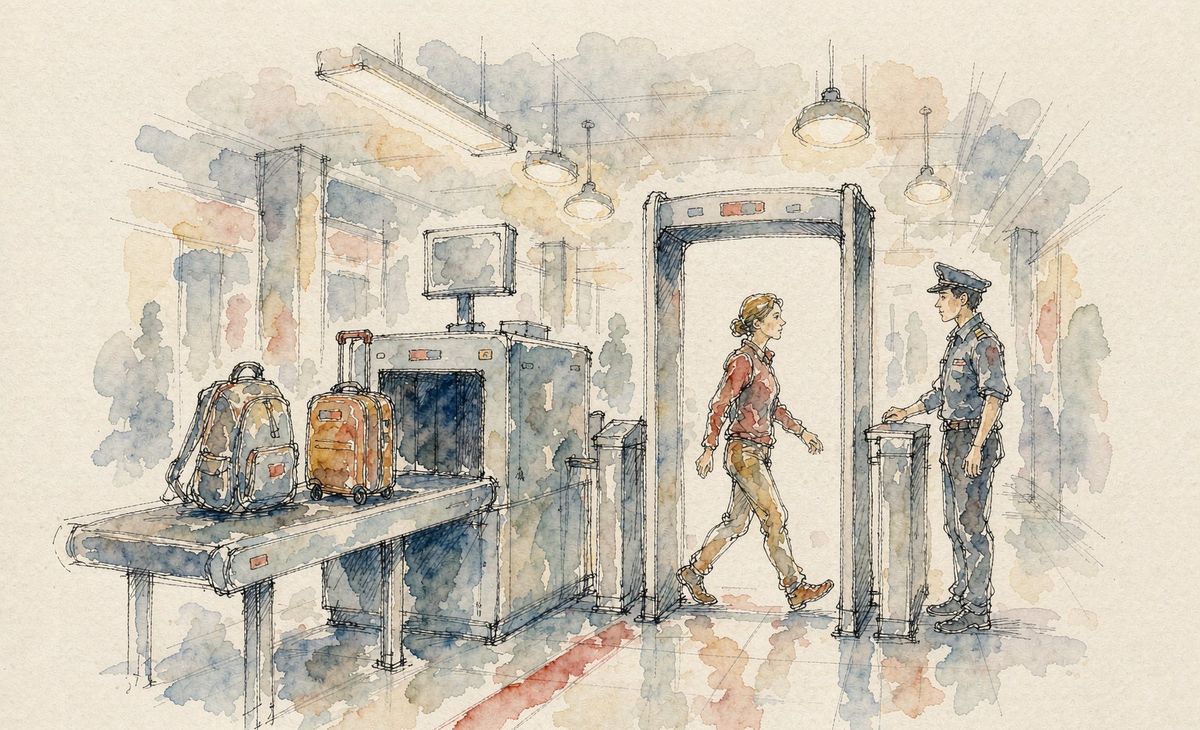
every entrance to every Chinese metro station runs a security checkpoint: bags and suitcases onto the x-ray belt, people through the arch, occasionally a quick wand check or a swab of a liquid bottle. it takes ten seconds when quiet, five to ten minutes at peak hours in the big interchange stations, and it is not optional: refusing the check means refusing entry. build the checkpoint into your time math the way you would build in airport security, and at rush hour prefer a station entrance one block off the main one, where the queue is usually shorter.
what the belt actually rejects is narrower than new arrivals fear. the published passenger rules for Shanghai (effective March 2025) and Beijing list the standard set: flammables and pressurized fuel, weapons and controlled knives, animals other than guide dogs, helium and inflated balloons, fireworks, and items whose smell clears a carriage on its own. liquids are x-rayed rather than banned; a water bottle rides along, occasionally opened for a sniff test. power banks are where cities diverge: none of the big operators checks the safety certification the way rail and airlines do, but several cap quantity and capacity: Guangzhou allows up to five units at no more than 20,000 mAh each (and bans using them on board), Shenzhen caps two units, while Beijing, Shanghai, Chengdu, and Hangzhou had no stated numeric limit when operators were asked in July 2025. the ceiling that satisfies every city is two clearly-labeled units at or under 20,000 mAh, which matches what you would pack for the train anyway, and the train ticket guide covers the stricter rail rules.
luggage rides free and unchecked for count, but not unlimited in size. Shanghai's rule caps a single item at 30 kilograms, 0.2 cubic meters, and no side longer than 1.8 meters in total dimension terms, comfortably above a 28-inch suitcase, below furniture. folding bicycles occupy a gray zone: the 2025 Shanghai rule bans bikes outright, while the operator has since said fully folded and wrapped folding bikes may enter with conditions, so ask staff rather than argue with a gate.
Reading a station without Chinese
the station itself is friendlier than its size suggests. line numbers stay constant in every language; a sign for "Line 2" is the same characters everywhere, and direction is signed by the end-of-line station name, so you learn to think "toward Century Avenue" rather than northbound. in Beijing, each station also carries a number code on network maps, which helps when station names blur together. English signage runs through the whole system in tier-one cities: exit letters, transfer corridors, platform screens, and recorded announcements all come paired, and the big stations add multilingual service desks.
the two things that actually cost time are transfers and exits. interchange corridors in giant stations (Beijing's Xizhimen, Shanghai's People's Square) can run ten walking minutes from platform to platform; the signs count the distance honestly, so follow the line number and color and ignore how far it feels. exits are lettered A, B, C, D (with numbered sub-exits A1, A2), and the wrong letter can put you a full block or, near a walled compound, half a kilometer from your destination. check the little exit diagram on the platform or the wall map before ascending, and remember the exit you want is usually printed in your maps app, and the AMap guide shows the exit recommendation right in the route card.
Last-train arithmetic
the Chinese metro is not a night bus. most lines start between 05:00 and 06:00 and stop around 22:30 to 23:30, and the published last train is when it leaves the terminus, and your station's last train comes earlier, sometimes much earlier, because of the travel time from the end of the line. Beijing's Line 1, for example, departs its western terminus at 22:47 on the last full run, while stations deeper in the network see trains past 23:30; Shanghai's Line 1 leaves Xinzhuang at 22:32 on the last through train, with Friday and Saturday late services pushing some departures toward midnight. Shanghai's maglev ends even earlier: last departure from Longyang Road at 21:40, from the airport at 21:42.
two habits make the schedule harmless. first, check the last-train time for your specific station once, on the first evening, in the maps app or on the board at the gate; it is printed in English everywhere. second, know the fallback: taxis and ride-hailing run all night in every tier-one city, and a late-night DiDi across town typically costs RMB¥30 to RMB¥60, several times the metro fare but trivially cheaper than a missed flight, and the DiDi guide covers the English app. for departures before the first metro, the same fallback applies in reverse.
The rules with teeth
most metro rules are etiquette with signage. a few have actual consequences. eating and drinking inside carriages is prohibited in Beijing and Shanghai (infants and medical needs excepted, and staff treat a closed coffee cup on the platform as fine); smoking, including e-cigarettes, is banned throughout the system and the smoke alarms in carriages are as touchy as the ones on trains; playing audio without headphones is a listed violation in both cities' passenger codes. fare evasion is the expensive one: Beijing's rules set the penalty for gate-jumping or using altered tickets at ten times the network's highest single fare, and repeat unruly behavior lands in the city's credit records rather than a fine book.
children ride free at 1.3 meters and below in Beijing, Shanghai, and Guangzhou (Shenzhen draws the line at 1.2 meters), one child per adult through the wider "priority" gates, and strollers go through the accessible gate with staff assistance. priority seats are universal and universally respected. the trains are quiet by local standard, phone calls are brief, and nobody expects you to give up your seat to them, but an elderly passenger standing next to a visibly occupied priority seat will draw looks from the whole carriage.
Common questions about the metro in China
Can foreigners use their own bank cards at Chinese metro gates?
Yes in the cities that matter most to visitors. Beijing's full network and Shanghai's entire system accept contactless Visa, Mastercard, American Express, JCB, and UnionPay cards directly at the gates; Chengdu, Guangzhou, and Shenzhen joined during 2025 and mid-2026. The card needs the contactless feature enabled, and your bank must allow small overseas transactions without a PIN prompt.
How do I pay for the subway in China without installing an app?
Three ways, in order of convenience: tap the contactless bank card at the gate; buy a single-journey token or ticket at a machine, which in Beijing takes coins, RMB¥5–50 notes, and cards; or buy from the staffed service counter, where Shanghai keeps foreign-card POS terminals at every station. Day passes are sold the same way.
How much does the metro cost in China?
Distance-based and cheap. Beijing and Shanghai start at RMB¥3 for the first 6 kilometers, Guangzhou, Shenzhen, and Chengdu at RMB¥2 for 4 kilometers, and a typical cross-city ride lands between RMB¥3 and RMB¥7, roughly US$0.42 to US$1. Airport express lines bill separately: RMB¥25 flat to Beijing Capital airport, RMB¥10–35 to Daxing, and Shanghai's maglev is RMB¥50, or RMB¥40 with a same-day flight ticket.
What time does the metro close in China?
Earlier than most visitors expect. Most lines run from about 05:00–06:00 to 22:30–23:30, and the published last train leaves the terminus, so your station stops earlier. Beijing's Line 1 last full departure is 22:47 from its western end; Shanghai's Line 1 leaves Xinzhuang at 22:32 on weekdays, with some Friday and Saturday extensions toward midnight; the Shanghai maglev stops at 21:40. Check your own station once and you will never guess again.
Is there a security check at Chinese metro stations?
At every entrance, every time: bags through the x-ray, you through the arch. It adds seconds when quiet and five to ten minutes at peak hours in the biggest interchanges. Liquids are screened rather than banned, and the standard prohibitions are weapons, flammables, pets, and inflated balloons.
Can I eat or drink on the Chinese subway?
Not inside the carriages. Beijing and Shanghai both prohibit eating and drinking on trains, with infant and medical exceptions, and staff will stop you; the enforcement is a conversation, not a fine, but the rule is real and locals follow it. Water on the platform is a non-issue everywhere.
Is there a day pass, and is it worth it?
Beijing sells one-, two-, three-, five-, and seven-day passes at RMB¥20/30/40/70/90 (electronic, unlimited); Shanghai has a one-day at RMB¥18 and a three-day at RMB¥45; Guangzhou charges RMB¥20 and RMB¥50. A normal sightseeing day costs RMB¥12–16 in fares, so the pass pays off only on heavy days: five or more rides, or a far-out hotel. Tap the card and skip the pass otherwise.
Can I bring a suitcase on the metro?
Yes, and nearly everyone does at the airport stations. Shanghai caps one item at 30 kilograms and 0.2 cubic meters with a 1.8-meter dimension total, which fits a large checked suitcase with room to spare. Elevators exist at every station for the deep concourses; follow the accessible-path signs rather than hauling a case up stairs.
Why was my card charged the maximum fare?
An incomplete journey: the gate saw you tap in but not out, or you tapped in with one form of the card and out with another (physical card versus the same card in a phone wallet counts as two tickets). Beijing's rules say the system then charges the highest fare from your entry station until corrected. Take the same card to a staffed window or use the app's ride history, and the charge is adjusted to the real trip.