China never stopped accepting money. It changed the shape of the counter. A hotel desk still has a card terminal behind the monitor. The noodle shop two streets away has a laminated QR code taped to the till and no card reader at all. Both take payment, and one wallet does not always cover both.
The question is not whether you can pay in China. It is which rail the counter in front of you happens to be on.
i learned this at a pharmacy in Kunming, holding a card that worked at the airport an hour earlier. the woman behind the counter turned the terminal toward me, tapped the screen twice, and pointed at a sticker the size of a stamp: Alipay or WeChat only. i paid cash, walked out with the medicine, and started carrying both from then on.
Three rails, one wallet
Every payment you make on a normal trip runs through one of four options. They differ in where they work, what they cost, and how long they take to set up.
| rail | where it works | what it costs | setup |
|---|---|---|---|
| contactless card or Apple Pay, tapped | hotel desks, airports, large malls, Starbucks, Shanghai metro gates | no platform fee; your issuer's foreign transaction fee, usually 0 to 3% | none |
| Alipay or WeChat Pay with a foreign card | nearly every shop counter, taxi, vending machine, restaurant, online order | nothing up to RMB¥200 per transaction, 3% of the full amount above it | 15 minutes, passport, phone that receives SMS |
| TenPayGo | the same merchant network as WeChat Pay | same RMB¥200 line, same 3% | 5 minutes, email address |
| cash | markets, temples, village shops, deposits, and anywhere the first three fail | face value, plus whatever your ATM charges | one ATM stop |
The practical stack for most visitors is one card, one wallet, and a few hundred yuan in notes. That covers a card terminal, a QR code, and the cash-only corner that neither of them reaches.
The RMB¥200 line decides your fees
Both Alipay and WeChat Pay charge foreign-card users the same way, and the rule is sharper than most guides admit. A transaction at or below RMB¥200 carries no service fee. A transaction above RMB¥200 carries 3% of the entire amount, not 3% of the excess.
| bill | service fee | you pay |
|---|---|---|
| RMB¥28 coffee | RMB¥0 | RMB¥28 |
| RMB¥200 thin-crust pizza | RMB¥0 | RMB¥200 |
| RMB¥201 bowl of noodles and a beer | RMB¥6.03 | RMB¥207.03 |
| RMB¥600 dinner for two | RMB¥18 | RMB¥618 |
| RMB¥3,000 hotel bill | RMB¥90 | RMB¥3,090 |
One yuan over the line costs RMB¥6.03 in fees. That cliff is why a wallet is excellent for a day of small purchases and expensive for a single large one.
You can split a bill across several scans if the merchant allows it, and three scans of RMB¥200 do avoid the fee on a RMB¥600 dinner. Do not build a habit on it. Cashiers have queues behind you, some tills only generate one code per order, and repeated split payments on a fresh card can trip the risk checks that freeze a wallet at the worst moment.
Refunds follow the same proportion. If you return a RMB¥600 purchase, the RMB¥18 comes back with it. Tencent states this in its own foreign-card FAQ, and Alipay works the same way.
Pay large amounts with the card itself and small amounts with the QR code. A RMB¥3,000 hotel bill tapped on a terminal costs only whatever your bank charges for currency conversion, often nothing on a travel card. The same bill paid by QR code adds RMB¥90 before your bank adds anything. Add a typical 2.5% issuer fee on top of the 3% and the QR route can reach 5.5% on a single payment.
Fifteen minutes of setup, ideally before you fly
Both apps work with an overseas phone number, so a Chinese SIM is not a prerequisite. What you need is a passport, a card that allows cross-border payments, and enough signal to receive one SMS.
- Install before departure. The App Store works in China, Google Play does not. Download Alipay and WeChat at home, where the connection is not the bottleneck.
- Register with a number that roams. Your home number is fine as long as it receives texts while abroad. A number you are about to cancel is not.
- Verify with the passport. Type your name exactly as the passport prints it, surname first. A middle name dropped here becomes a failed identity check later.
- Link the card and spend RMB¥1. Buy a bottle of water while still on hotel wifi. A card that binds but cannot authorize is a card you want to discover on a quiet afternoon, not at a taxi window at midnight.
Alipay and WeChat Pay differ enough in registration and verification that each has its own walkthrough: Alipay from install to first scan and WeChat Pay and its verification steps. If you plan to stay longer than a holiday, a local bank account removes most of the limits described below.
TenPayGo, the September 2026 shortcut
Tencent released a standalone payment app on 24 September 2026 called TenPayGo, built by the WeChat Pay team for short-term visitors. It appeared on the App Store in June and went public in Shenzhen in September, ahead of the APEC meetings that city hosts in November.
What makes it different is the front door. You register with an email address. No WeChat account, no mainland phone number, no Chinese bank card. Inside, you link an international card from the seven major networks, an Apple Pay card, or one of roughly sixty overseas wallets. Payment runs over the same merchant network as WeChat Pay, which is the widest QR network in the country.
Tencent bundled three travel tools into it: a transit code for Shenzhen's metro and buses through Shenzhen Tong, a camera translator for menus and street signs, and a link into departure tax refunds through a Shenzhen branch of ICBC. The interface is English only for now, and the iPhone version shipped first.
Choose it if you are here for a week or two and want to pay without handing a passport to a social app. Choose full WeChat Pay if you need mini-programs, a landlord, or a Chinese contact to send money, because TenPayGo is a payment tool and not a messaging account.
The digital yuan is the fourth rail and the quietest one. It runs on a separate wallet with no platform fee, its own spending caps, and a hard wallet you can tap at some metro gates; the e-CNY walkthrough covers where it earns its place.
The gate that reads your card
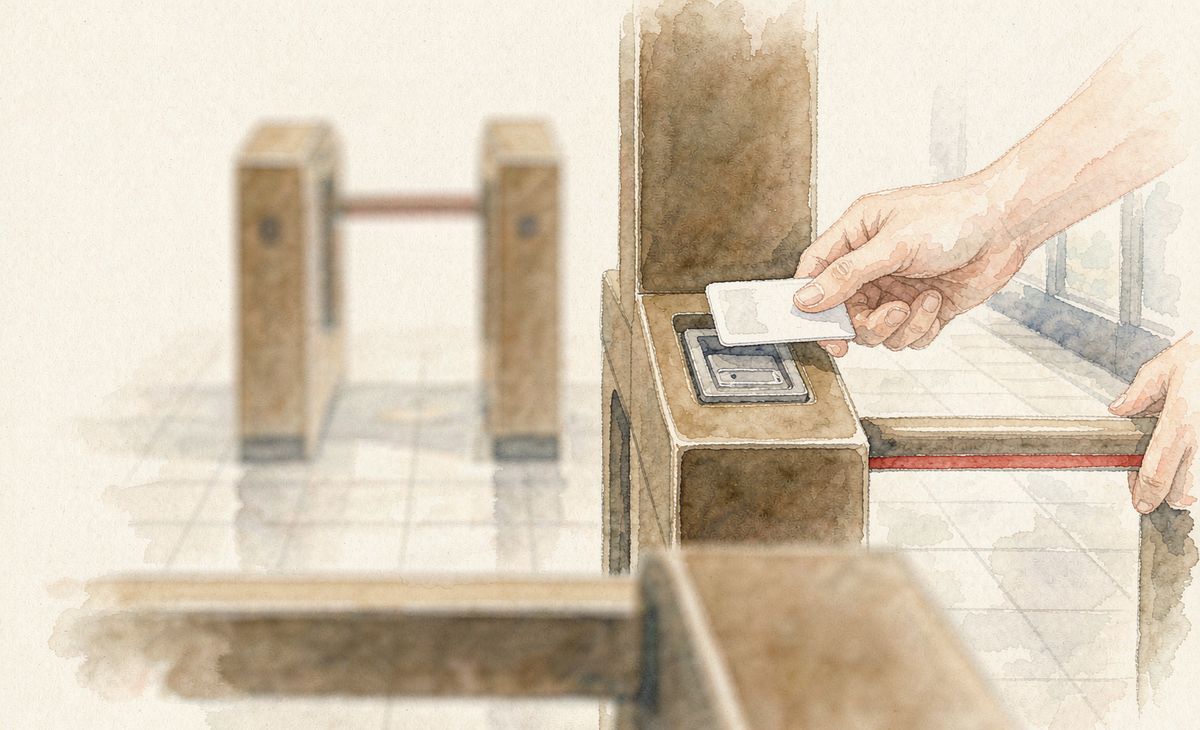
Shanghai Metro opened contactless bank-card entry across its entire network on 28 June 2025, after a trial on the Maglev line two weeks earlier. All 21 lines, 517 stations and 896 kilometres now accept a tap from a UnionPay, Visa, Mastercard, American Express or JCB contactless card, a phone wallet tied to one of those cards, or an e-CNY hard wallet.
The failure mode is almost never the bank. Two things stop a valid card at the gate: the card has no small-amount password-free payment enabled, or it carries a chip type the gate reader cannot process. Shanghai Metro excludes Type-B chips and cards without the ODA function. Dual-brand cards carrying both a foreign network logo and UnionPay settle through UnionPay.
Adoption has been steady rather than explosive: 1.6 million tap-through transactions worth over RMB¥7 million between the June 2025 rollout and March 2026, according to the Shanghai head office of the central bank. Other cities have been adding card readers at their gates too, but coverage changes by city and by line, so check the local metro site rather than assuming the Shanghai arrangement travels. Our metro guide covers tickets and apps for the cities that still need them.
What a foreign card cannot do
This is where most payment advice goes quiet. A foreign card inside Alipay or WeChat Pay buys goods and services. It does not move money between people.
- No personal transfers to a Chinese friend, landlord, or tutor.
- No red packets, in a group chat or one to one.
- No wealth products, insurance premiums, or other financial services.
The restriction is regulatory, not a bug in the app: cross-border capital-account transfers sit outside what these rails are licensed to do for foreign cards. The practical consequence matters more than the rule. Small vendors, market stalls, and private landlords often show a personal collection code rather than a merchant code, and a foreign card will usually fail against it. The same applies to splitting a dinner with friends and to paying a deposit on a flat.
Three workarounds cover most cases. Carry cash for personal codes. Ask a Chinese contact to pay and reimburse them in cash. Or open a local account, which turns the wallet into a normal one; our notes on sending money into China cover the funding side of that account.
Online shopping sits on the merchant side of that line, so the wallet pays fine there. Checkout on Taobao and the three marketplaces compared both stop at the same payment screen, and both need a verified wallet rather than a card number.
When cash is the only option
Cash has a legal floor under it. A State Council directive from March 2024 requires large business districts, tourist sites, hospitals, hotels and transport hubs to accept mobile payment, bank cards and cash, and it ordered continued enforcement against shops that refuse notes. Refusing cash is a violation, not a policy.
That said, a stallholder with RMB¥50 in the drawer cannot break a RMB¥100 note at nine in the morning. Keep small denominations. You may bring up to RMB¥20,000 in cash into the country, and foreign cards work in ATMs at Bank of China, ICBC and the airport branches, with your own bank setting the withdrawal fee.
Rough budget: RMB¥300 to RMB¥500 for a short trip, more if you plan to visit temples, rural areas, or anywhere you might pay a deposit. A hotel safe holding a few hundred yuan is cheaper than a failed payment at a bus counter. The daily cost breakdown puts those numbers next to everything else a day spends.
When a payment fails
Most failures fall into six patterns. The message on screen rarely names the real cause.
| what you see | what is actually wrong | what to do |
|---|---|---|
| card refused at binding | your issuer will not authorize cross-border linking, or its system cannot parse the request | try a second card; call the issuer and ask them to allow the merchant category |
| bound, but payment declines | single transaction above USD 5,000, or a first-use risk check | split the amount, or make one small purchase to warm the card |
| money left, merchant says unpaid | authorization hold, not a completed charge | wait 24 hours before filing anything; duplicate charges usually clear |
| scanning a personal code fails | foreign cards cannot transfer to a person | pay cash, or ask for a merchant code instead |
| metro gate will not open | small-amount password-free is off, or the chip type is unsupported | enable the feature in your banking app, or buy a single ticket |
| balance will not withdraw | funds loaded from a foreign card are spend-only | spend it down before you leave; it cannot go back to the card |
Two ceilings explain a share of declines. The central bank raised foreign-card limits in 2024 from USD 1,000 to USD 5,000 per transaction and from USD 10,000 to USD 50,000 per year. A luxury purchase or a long hotel bill can approach the first number without anyone warning you at the counter.
Refunds and disputes have their own path, covered in refunds and consumer disputes. If you bought goods to take home, the departure tax refund returns between 6% and 9% of the purchase price, and Shanghai now pays part of it straight into Alipay at the counter.
Common questions about paying in China
Can I pay in China without a Chinese bank account?
Yes, and most visitors do. Alipay and WeChat Pay both accept foreign cards from Visa, Mastercard, JCB, Diners Club and Discover, and TenPayGo accepts an email sign-up with no Chinese phone number at all. A local account only becomes necessary when you need to receive money, pay rent, or move amounts above the foreign-card ceilings.
Is Alipay or WeChat Pay better for a short trip?
Alipay has the cleaner English interface and slightly broader online coverage. WeChat Pay has the deeper hold on small merchants, mini-programs, and anything a Chinese contact needs to send you. Install both if you have ten spare minutes; the cost of carrying two is close to zero and each covers the other's outages. Our side-by-side comparison goes through the differences by situation.
Why did a RMB¥300 meal cost me RMB¥309?
Because the 3% foreign-card fee applies to the whole amount once a transaction passes RMB¥200. Three hundred yuan attracts RMB¥9. Your bank may add a foreign transaction fee of its own, typically 1% to 3%, so the real gap can be closer to RMB¥18. Paying that bill with the physical card at a terminal removes the platform's 3% entirely.
Can I split a payment to stay under RMB¥200?
Sometimes, if the merchant can generate more than one code for the same order. Many cannot, and cashiers will not enjoy the experiment during a lunch rush. Treat splitting as an occasional trick for a specific bill, never as a routine.
Does Apple Pay work in China?
At terminals that display the contactless symbol, yes, and it charges your home card exactly as a tap would. Those terminals are common in hotels, airports, chain coffee shops and larger retailers, and rare at the small restaurants and market stalls where most meals happen. Apple Pay also works inside TenPayGo, which extends it to QR merchants.
Can I send money to a Chinese friend through Alipay?
Not with a foreign card. Transfers, red packets and financial products sit outside what the foreign-card rail permits. Pay cash, or ask them to cover it and settle in notes. This is the single most common reason a payment fails in a situation that felt like it should work.
How much cash should I carry?
RMB¥300 to RMB¥500 for a normal week, in small notes. Add more if you will pay deposits, visit temples, or travel outside major cities. Bring no more than RMB¥20,000 into the country, and withdraw from an ATM rather than carrying the whole budget.
Do I need a Chinese phone number?
No for Alipay, WeChat Pay or TenPayGo, as long as your home number receives SMS abroad. A local number helps with restaurant queues, delivery apps, and any service that expects a mainland number for registration, which is a separate problem from payment.
What if a shop refuses cash?
It is breaking the rule. Large retail, hospitality and transport venues are required to accept cash, and enforcement has been active since 2024. In practice, pointing at the note and waiting usually resolves it; a stall with no change is a different situation from a shop with a policy.
Do refunds go back to my foreign card?
Yes, to the card you paid with, usually within three to seven business days, longer with small issuers. The 3% service fee returns in proportion, so a full refund returns the fee as well.
Set the wallet up before you land, tap the card for anything expensive, and keep a few hundred yuan for the counters that only take notes. That combination handles nearly every payment a visitor meets, including the ones no guide predicted.