No hotel in China may refuse a foreign guest for lacking a foreign-related qualification, because that qualification no longer exists. What the desk still owes the police is a registration it files on your behalf, within twenty-four hours, using the passport you hand over at check-in.
the sentence is delivered politely and it is almost always the same one: we cannot take foreign guests, we do not have the qualification. it comes from the desk of a budget hotel in a city that sees three foreign visitors a year, and it has been wrong since july 2024, when seven ministries wrote down that no accommodation business may be limited by a qualification requirement. the desk is not lying. it is repeating something it was told years ago and never told to forget.
what follows treats sleeping as a paperwork problem, because that is what it is. the choice of hotel is easy. the part that catches people is the registration attached to the bed, which the hotel owes the police, which you owe in every other kind of accommodation, and which moved online two months ago in a change most English-language guides have not caught up with. if the payment side is the part you are still unsure about, the guide to paying in China covers the card terminal at the desk and the cash rules that sit behind it.
The qualification that stopped existing
the phrase that causes the trouble is foreign-related qualification, a hangover from the 1980s and 1990s when a hotel needed a tourism licence to take foreign guests at all. that system was dismantled province by province, starting with beijing in 2003, and the last piece of it was formally closed in 2024 after foreign visitors posted complaints to the central government's own message board about being turned away.
the reply came from three ministries and it was unusually direct: the hospitality industry must not refuse foreign nationals on the grounds of lacking a foreign-related qualification. that answer was then written into policy. notice 324 of 2024, issued jointly by the ministry of commerce and six other departments, states that local authorities and booking platforms may not use qualification requirements as a threshold to limit which guests an accommodation business accepts, and that neither platforms nor hotels may publish notices saying they do not take foreign guests.
a year later the same ministry went further in the other direction. the 2025 guidance on high-quality development of the accommodation industry, signed by nine departments, devotes a clause to foreign reception: streamline the registration process, build out the online registration platform, raise the coverage of foreign-card terminals, add currency exchange counters inside hotels, and keep cash on hand. read together, the two documents say the direction of travel is more foreign guests rather than fewer, and that the state is paying for the terminals and the training to make that work.
| Instrument | What it says | Who owes the duty |
|---|---|---|
| Exit and Entry Administration Law, article 39 | hotels register foreign guests and report the information to the local police | the hotel |
| Public security rules for the hotel industry, article 6 | verify the identity document, register, and send the foreign-guest form to the police within 24 hours | the hotel |
| Ministry of Commerce notice 324 of 2024 | no qualification threshold, and no published notice refusing foreign guests | local authorities, platforms, hotels |
| Nine-department guidance, 2025 | improve registration, foreign-card terminals and exchange facilities | hotels, with local support |
| NIA announcement, September 21 2026 | online registration nationwide for stays outside hotels | the guest or the host |
none of this means every hotel will say yes with a smile. it means the reason given at the desk is not a legal reason, and knowing that changes what you do next, which is covered further down.
What the desk is afraid of
the practical reason a hotel refuses is rarely ideological and almost never about you. a front desk that has not checked in a passport in two years has a terminal it does not know how to operate, a registration screen with fields it has never filled, and a manager who has told the staff that a mistake on that screen is the hotel's problem rather than the guest's. refusing is the cheap option for them and the expensive one for you.
this is why the refusals cluster in a predictable way. international chains and four-star city hotels handle passports daily and will not blink. economy chains in a provincial capital usually manage. the small independent hotel near a train station, the family guesthouse on a mountain, the hourly room above a shop, those are where the sentence appears. the pattern is not about star rating. it is about how often the front desk sees a passport.
there is one signal worth checking before you pay, and it is a signal that should not exist. platforms were told in 2024 not to publish notices refusing foreign guests, and most complied, but a listing that says foreigners not accepted still surfaces on some platforms in Chinese. treat it as accurate information about that property's ability rather than as law. the property can legally take you. it has told you it will not, and arguing with a listing at midnight is not a plan.
Who files the paper
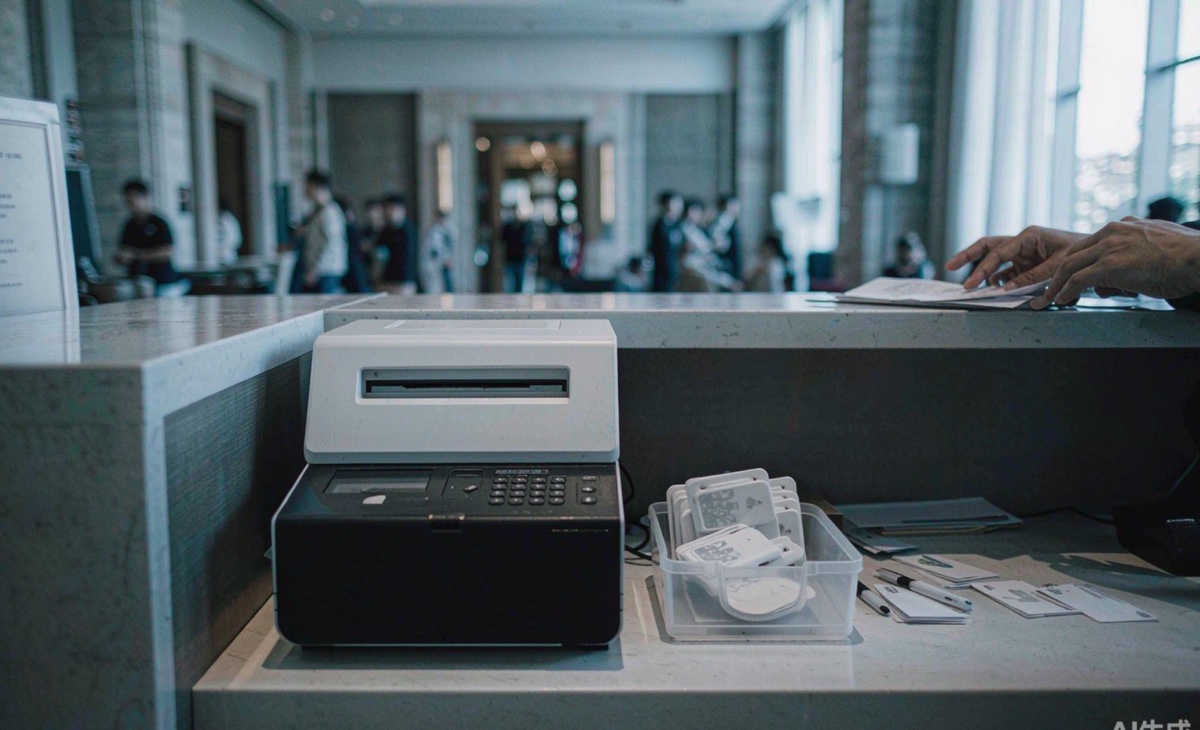
the split runs on one question: is the place a hotel or is it something else. for a hotel, the registration is the hotel's job from start to finish. you hand over the passport, the front desk scans it, the record goes to the local police within twenty-four hours, and you do nothing further. this is the single most useful fact in this guide, because it means a hotel stay carries no errand and no risk of a fine.
for everything that is not a hotel, the duty moves to you or to whoever is hosting you. a friend's spare room, a rented apartment, a homestay, a room in someone's house, all of it falls under the same rule: register within twenty-four hours of moving in, counted from the hour you arrive rather than from the calendar day. the guide to renting an apartment covers the lease side of that in detail. what changed recently is how you file it.
since september 21, 2026, the registration for stays outside hotels can be completed online anywhere in the country, through the immigration administration's service website, its 12367 app, or the 12367 mini programs inside WeChat and Alipay. the online route has the same legal effect as walking into a police station, and the counter route still exists for anyone who prefers it. the pilot ran from march 2026 in hebei, liaoning, zhejiang, hubei, guangxi, chongqing and sichuan before going national, which is why older guides describe it as a regional service.
skipping it is not a technicality. the exit and entry law sets a warning plus a fine of up to RMB¥2,000 for a foreigner or a host who fails to register, and police do enforce it against hosts who take payment for a room without reporting the guest. the amount is small and the record is not, since it sits in the immigration system that later decides visa extensions and residence permits.
The exception in local rules
here is the part that almost no English-language guide says plainly, and it is the reason this page exists. the national rule removed the qualification threshold. local rules for a category called online-booked rooms, meaning apartments and houses let by the night without a hotel licence, have not all followed, and some of them say the opposite in black and white.

the changbaishan rules for homestays and online-booked rooms, in force since may 2026, list among the operator's obligations that rooms may not be given to anyone without valid identification and that receiving foreign nationals is prohibited. that is a local regulation for a mountain tourism zone, not a national policy, and it sits in direct tension with the 2024 notice. zhejiang went the other way in its own rules for the same category of property, requiring the operator to register a foreign guest with the local police station within twenty-four hours and specifying which fields to send, which only makes sense if the guest is allowed to be there.
the result is a country where the same booking can be fine in one province and forbidden in another, and where the platform will not tell you which. the only workable method is to ask the property directly, in writing, before paying: can you complete the accommodation registration for a foreign passport. a property that answers yes has done it before. a property that answers with enthusiasm and no specifics has not. shanghai's chongming district has been running a scheme where homestays apply to the local police station for foreign reception, which is the direction the rest of the country is moving in, but a scheme in one district is not a rule for the country.
the practical ranking, then, is hotels first, serviced apartments with a staffed front desk second, and anything that sends you a door code last. if a listing's only contact is a lockbox code, nobody is there to file the registration, and the twenty-four hour clock is now your problem alone.
Deposit, card, receipt
the money side of a Chinese hotel is simpler than the paperwork side and has three parts worth knowing before you arrive. the first is the deposit, which is a custom rather than a regulation: the desk will ask for the room charge plus a hold, often the price of one night or a flat RMB¥200 to RMB¥500, returned at checkout after someone checks the room. it is normally taken as a card pre-authorisation or in cash, and a cash deposit is the one case where you should count the notes in front of the clerk and keep the slip.
the second is the card terminal. people's bank guidance for shanghai states that foreign-card acceptance now covers airports, major commercial districts, three-star hotels and above, and the 2025 nine-department guidance asks hotels to raise terminal coverage further. in practice a four-star hotel takes Visa and Mastercard without discussion, a mid-range chain sometimes does, and a small hotel may hand you a QR code instead. the fallback is your own Alipay or WeChat wallet bound to a foreign card, which is covered in the payment guide, or cash, which hotels are required to accept.
the third is the receipt, and it matters more to a business traveller than to anyone else. a Chinese hotel issues a fapiao, an official tax invoice, and it can only be issued for the name and tax number you supply. ask at check-in rather than at checkout, because the desk that has already closed your folio is the desk that has to reopen it. for a leisure stay you will never need one. for a claim, the fapiao is the only document an employer will accept.
Children and the five checks
a family arriving with children meets a set of rules that were written to stop child trafficking and that read, at a foreign family's first encounter, like an interrogation. hotels and other accommodation are required to apply five checks to any minor checking in: verify the child's identity document, ask for a parent or guardian's contact details and record them, ask about the relationship between the adults and the child and record that too, increase floor patrols, and report anything suspicious to the police.
in practice this means a family with a different surname from the child, or an adult travelling with someone else's child, should carry a birth certificate or a signed letter from the parent. it also means a hotel may ask a child for their own passport rather than accepting the parent's. none of this is aimed at foreigners and none of it can be waived at the desk, so the workable preparation is documents rather than argument. the packing list in what to pack for China covers the document folder, and a birth certificate belongs in it if you are travelling with children.
Eleven at night at the desk
the refusal is real, it happens, and the response that works is procedural rather than emotional. four steps, in order, and the first one costs nothing.
| Step | What to do | Why |
|---|---|---|
| 1 | confirm the booking is at this property, for tonight, under this name | rules out a wrong branch or a cancelled reservation dressed up as a policy problem |
| 2 | ask for the duty manager and for the exact reason in one sentence | the qualification answer collapses when it has to be written down |
| 3 | open a ticket with the booking platform without cancelling anything | a self-cancellation becomes a no-show, and the refund argument is lost |
| 4 | move, then complain | at midnight with children, a confirmed room two streets away beats being right |
the complaint channels have different jobs, and using the right one saves a day. 12367 is the immigration administration's service line and handles registration policy and visa matters. 12345 is the local government's general line and will route a complaint about a business in its jurisdiction. 12315 handles consumer disputes with a hotel or a platform when money is at stake. 110 is for a real emergency and will not help with a refund.
keep four things: a dated screenshot of the listing as it appeared when you booked, the refusal in writing if the desk will give it, the platform ticket number, and receipts for whatever the alternative room cost. the last one is what turns a complaint into a claim.
What a room costs
the ministry of culture and tourism publishes an average for star-rated hotels, and the figure in the 2025 statistical bulletin is RMB¥360.2 per room per night across 7,586 star-rated properties, with an average occupancy of 46.8 per cent. that average is a useful anchor and a misleading expectation at the same time, because it covers only the graded stock and it pools shanghai with a county town.
the practical spread in late 2026 runs roughly like this. an economy chain room outside the centre of a second-tier city sits at RMB¥150 to RMB¥300. a mid-range chain in a good location in a major city runs RMB¥300 to RMB¥600. an international five-star in shanghai or beijing starts around RMB¥800 and goes up without much of a ceiling during a holiday week. the three national holiday periods and the first week of october are the ones where a room doubles, and the guide to the 2027 holiday calendar is the one to check before fixing dates.
two smaller money notes. a platform's diamond rating is a commercial label rather than the official star grade, and the two are not the same thing, so a listing described as four-diamond may hold no star rating at all. and breakfast is usually included in a Chinese chain hotel rate and usually not in an international one, which moves the real comparison by RMB¥40 to RMB¥80 a head.
Common questions
Can foreigners stay in any hotel in China?
In law, yes, with no qualification threshold and an explicit ban on refusing foreign guests for lacking one. In practice, international chains and four-star city hotels take passports as routine, while small independent hotels and guesthouses in places that rarely see foreigners may still say no. That refusal is a service failure rather than a legal barrier, and the answer is to move rather than to argue at midnight.
Do I have to register with the police if I stay in a hotel?
No. The hotel does it, under article 39 of the exit and entry law and article 6 of the public security rules for the hotel industry, which require the guest form to reach the local police within twenty-four hours. You hand over the passport at check-in and the rest is the front desk's job. The twenty-four hour rule becomes yours only when you stay somewhere that is not a hotel.
What if the hotel says it has no foreign-related qualification?
The qualification no longer exists. Beijing abolished its designated-hotel system in 2003, and in 2024 the ministry of commerce and six other departments banned qualification thresholds and banned publishing notices that refuse foreign guests. Ask for the duty manager, ask for the reason in one sentence, and open a platform ticket without cancelling. Then take a room elsewhere and complain with the evidence.
Can I stay in an Airbnb or homestay in China?
Sometimes, and the answer depends on the province rather than on the platform. National policy removed the qualification threshold, but local rules for online-booked rooms have not all followed: the changbaishan rules in force since May 2026 prohibit receiving foreign nationals outright, while zhejiang requires the operator to register a foreign guest with the police within twenty-four hours. Ask the property in writing whether it can complete your accommodation registration before you pay.
Why do hotels ask for a deposit?
Custom, not regulation. The desk asks for the room charge plus a hold, commonly one night's rate or a flat RMB¥200 to RMB¥500, and returns it after a room check at checkout. It is usually a card pre-authorisation, sometimes cash. If you pay cash, count the notes at the desk and keep the slip, because the deposit is the one part of a hotel bill that depends on someone else's inspection.
Do hotels in China take foreign credit cards?
Three-star and above, generally yes, and people's bank guidance for shanghai describes foreign-card acceptance as covering airports, major commercial districts and hotels at that level. Mid-range chains vary, and small hotels may only offer a domestic QR code. Keep a foreign-card wallet on Alipay or WeChat as the fallback, and remember that hotels are required to accept cash as well.
Will my children need their own documents to check in?
Possibly. Accommodation applies five checks to any minor: identity document, guardian contact, the relationship between the adults and the child, patrols, and reporting anything suspicious. A child travelling with parents of a different surname, or with an adult who is not a parent, should carry a birth certificate or a signed letter. The rules exist to stop trafficking and they cannot be waived at the desk.
What is the 24-hour rule and does it apply to hotels?
Stays outside hotels must be registered within twenty-four hours of arrival, counted from the hour you arrive rather than by calendar day. Hotels are exempt because the hotel files the registration itself. Since September 21, 2026 the outside-hotel registration can be done online nationwide through the 12367 app or the immigration service website, with the same effect as a police station visit.
Is it cheaper to book on a Chinese app?
Often, but the gap is smaller than the effort. Chinese platforms show domestic rates that foreign-facing sites mark up, and the same chain can differ by RMB¥50 to RMB¥100 a night. The catch is that a Chinese-language listing may be silent about foreign reception at a small property, while a foreign-facing site usually has already filtered those out. Compare both, then confirm registration directly with the property.
What number do I call if I am refused?
12367 for immigration and registration policy, 12345 for a complaint routed to the local government, 12315 for a consumer dispute over money, and 110 only for a real emergency. Keep the dated listing screenshot, the refusal, the platform ticket and the receipts for the alternative room, since those are what turn a complaint into a claim.